Bathroom ventilation in the Netherlands (2026): the rules, what it costs and how to stop mould for good
If you moved into a Dutch apartment and found black spots in the shower sealant within a year, you are not doing anything wrong. Dutch homes are well insulated and airtight, bathrooms are small, and in older Amsterdam, Utrecht and Rotterdam buildings they often have no window at all. One hot shower releases a litre to a litre and a half of water into the air; if that air is not extracted within half an hour, it condenses on the coldest surface and mould follows. This guide explains how bathroom ventilation works in the Netherlands, what the Dutch building code requires (14 dm³/s for a bathroom), what an extractor fan, a new ventilation unit or heat recovery costs in 2026, what to do in a windowless bathroom, who pays when you rent, and why the cheapest moment to fix it is during a bathroom renovation. We include ventilation in every renovation we do, because a new bathroom with poor extraction has mouldy grout again within two winters.
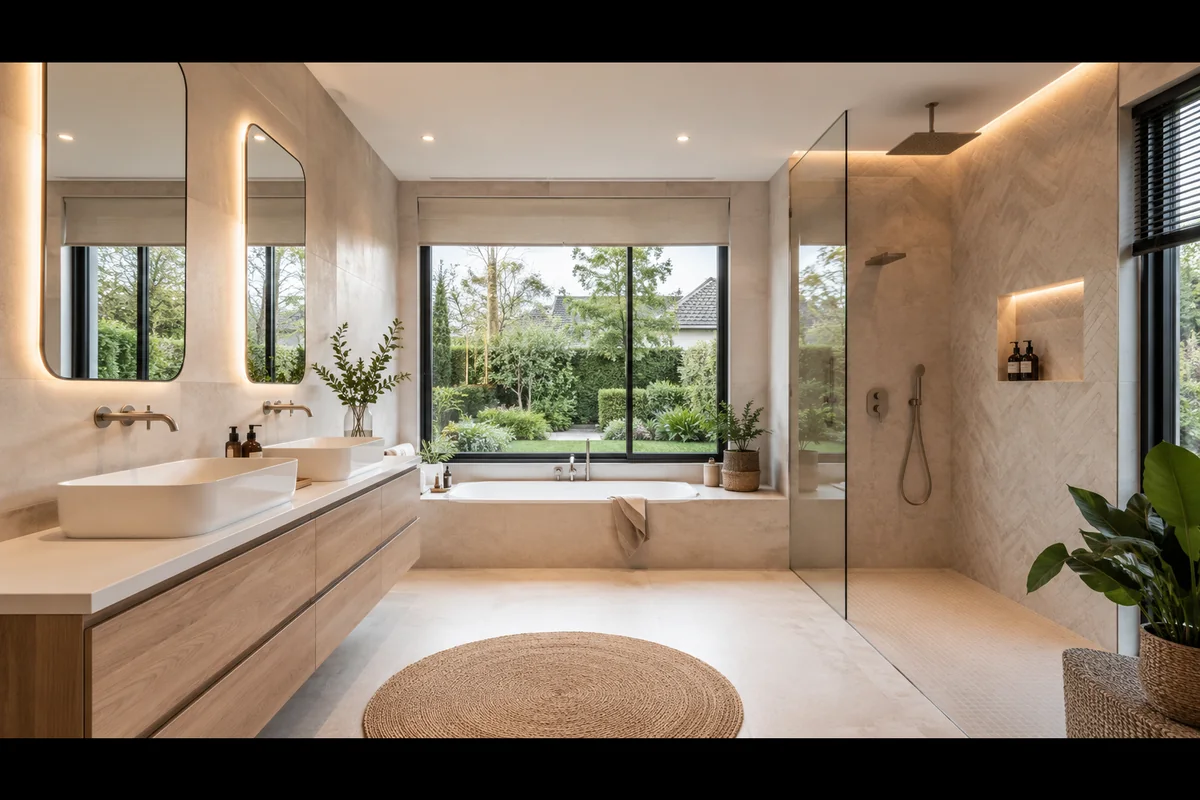
Bathroom ventilation costs in the Netherlands 2026: at a glance
| Solution | Installed price (2026, incl. 21% VAT) | Best for |
|---|---|---|
| Basic extractor fan (switched with the light) | €150 – €250 | Small bathroom with a window and an existing duct |
| Fan with run-on timer | €200 – €300 | The standard choice for a windowless bathroom |
| Fan with humidity sensor (switches itself) | €250 – €500 | Families, rentals, anyone who does not want to think about it |
| Extra extraction point on an existing central unit (MV box) | €250 – €450 | Homes with central extraction but no valve in the bathroom |
| Replacing the central MV box with a quiet DC unit | €450 – €900 | Unit older than 15 years, noisy or weak |
| Demand-controlled MV box with humidity/CO₂ sensors | €800 – €1,500 | Energy-efficient, fully automatic, whole home |
| Decentralised heat-recovery unit (through the outside wall) | €500 – €1,200 | Bathroom on an external wall where ducting is impossible |
| Central heat recovery (system D, whole home) | €4,000 – €8,000 | Major renovation or energy upgrade |
| New roof or wall outlet for the duct | + €150 – €400 | When the fan currently vents nowhere |
Prices include installation by a registered electrician or installer (€55 – €85 per hour) and VAT. The hardware itself is cheap: a good humidity-sensor fan costs €80 – €200, a central MV box €250 – €600. The rest is ducting, wiring and making good afterwards. If the work is done as part of a bathroom renovation, most of that labour disappears, because the ceiling and walls are open anyway.
Why Dutch bathrooms get mouldy
Three things come together in the Netherlands. First, the climate: the outside air is humid for most of the year, so "just open a window" removes far less moisture than it would in a drier country. Second, the building stock: pre-1975 houses and canal-house apartments were built with natural ventilation, and decades of double glazing, draught-proofing and insulation have made them nearly airtight without adding mechanical extraction. Third, the floor plans: Dutch bathrooms average 4 to 6 m², and in apartments they are frequently internal rooms with no window.
The physics is simple. A ten-minute hot shower pushes the relative humidity to 90 – 100%. Warm air holds that moisture; as it cools, or touches a cold surface such as an external wall, a window or an unheated tiled wall, it condenses. If the humidity is not back below 60 – 70% within 20 to 30 minutes, mould spores germinate on sealant, grout, the ceiling and behind the vanity unit. Beyond the stains, chronic damp destroys silicone and grout, lets water get behind tiles, lifts paint and plaster, rots timber and aggravates asthma and allergies. A healthy bathroom is back under 60% humidity within half an hour of showering; a €10 hygrometer will tell you where yours stands.
What the Dutch building code requires
Since 1 January 2024 the Dutch building regulations live in the Besluit bouwwerken leefomgeving (Bbl), the successor of the Bouwbesluit. The ventilation rules for wet rooms barely changed, but the numbers are worth knowing when you compare quotes or argue with a landlord.
| Room | Minimum extraction capacity (Bbl art. 3.67 / 4.122) | In m³ per hour |
|---|---|---|
| Bathroom (badruimte, with or without toilet) | 14 dm³/s | ≈ 50 m³/h |
| Separate toilet (toiletruimte) | 7 dm³/s | ≈ 25 m³/h |
| Living room / bedroom | 0.7 dm³/s per m², minimum 7 dm³/s | ≈ 2.5 m³/h per m² |
| Kitchen with a cooker | 21 dm³/s | ≈ 75 m³/h |
Those 14 dm³/s apply to existing homes as well as new builds and they are a legal minimum. In practice we, like most Dutch installers, recommend 75 to 100 m³/h of real extraction for a 5 – 8 m² bathroom, because a fan rated "100 m³/h" on the box typically delivers 60 once it is connected to three metres of duct with two bends. Capacity is measured according to NEN 8087. An openable window counts as natural air supply under the Bbl, but not as the required extraction for a bathroom: a bathroom with a window should still have a mechanical or natural exhaust that can move 14 dm³/s.
Ventilation systems A, B, C and D: which one does your home have?
Dutch installers classify home ventilation into four systems. Knowing yours tells you which bathroom fix makes sense.
| System | Supply | Extraction | Typical homes | Bathroom fix |
|---|---|---|---|---|
| A – natural | Trickle vents, windows | Natural draught via a duct or window | Pre-1975 houses, canal houses, most 1930s homes | Add an extractor fan with timer or humidity sensor |
| B – mechanical supply | Fan blows air in | Natural | Rare in housing | Same: add extraction |
| C – mechanical extraction | Trickle vents in the window frames | Central MV box in the attic or storage room | Almost every home built 1975 – 2015 | Re-balance the bathroom valve or replace the box |
| D – balanced ventilation with heat recovery (WTW) | Mechanical, pre-heated | Mechanical, heat recovered | New builds after 2015, deep renovations | Have the bathroom flow set correctly, change filters |
In a system C home the bathroom hangs off the central unit through a round valve in the ceiling; the thing humming in the attic cupboard is the MV box. If extraction is poor, the cause is usually a clogged valve, a badly balanced system (the kitchen takes everything) or a worn-out 20-year-old box. Adding a separate extractor fan to a system C home rarely helps: you create two systems fighting each other. Have the box and the balancing checked first.
Ventilating a bathroom without a window
Windowless bathrooms are the norm in Dutch apartments and terraced houses. With no window you have no natural supply and no natural exhaust, so the air has to be refreshed entirely mechanically. Three things must be right.
1. The duct must go outside. A fan that blows into a void, a crawl space or the attic just moves the damp problem. The duct (usually Ø 100 or Ø 125 mm) has to exit through the roof or the façade, with a backdraught shutter against cold air and a grille against birds and insects. If there is no outlet yet, budget €150 – €400 to create one.
2. Fresh air must be able to get in. Extraction only works if air can replace what is removed. That happens through a gap of at least 1 – 2 cm under the bathroom door or a grille in the door. A door that was trimmed flush with a new laminate floor is a classic reason why a perfectly good fan "does nothing".
3. The fan must keep running after you leave. Most of the moisture is released in the 20 – 30 minutes after a shower, not during it. A fan wired to the light switch stops exactly when it is needed. Choose a fan with a run-on timer (adjustable 5 – 30 minutes) or, better, a humidity sensor that starts at 60 – 70% relative humidity and stops when the room is dry.
Choosing an extractor fan: the specifications that matter
| Specification | Our recommendation for a 5 – 8 m² bathroom | Why |
|---|---|---|
| Capacity | 75 – 100 m³/h net (Ø 100 mm below 6 m², Ø 125 mm above) | Legal minimum is 50 m³/h; ducting costs 20 – 40% |
| Control | Humidity sensor (hygrostat) with run-on timer | Automatic, never misses the drying phase |
| Noise | ≤ 30 dB(A) at 3 m, ideally 20 – 26 dB(A) | Above 35 dB(A) people switch it off |
| Protection rating | IPX4 minimum; IPX5 or 12 V via a safety transformer above the shower or bath | NEN 1010 wet-room zones |
| Backdraught shutter | Built in or fitted in the outlet | Stops cold draughts when the fan is off |
| Ball bearings | Yes, for daily use | 30,000 – 40,000 hours instead of 10,000 |
| Power use | 8 – 20 watts | A sensor fan costs €5 – €10 a year to run |
The most common mistake is buying a small fan because the old one looked small. Size the fan to the room: volume (length × width × height) times 6 to 8 air changes per hour. A 6 m² bathroom with a 2.6 m ceiling is 15.6 m³ and needs 95 – 125 m³/h net. That is a Ø 125 mm fan, not a Ø 100.
Costs in detail: material, labour and total
| Job | Material | Labour | Total (2026) |
|---|---|---|---|
| Replace an existing fan like for like | €40 – €120 | €100 – €150 (1 – 1.5 h) | €150 – €250 |
| New humidity-sensor fan on an existing duct | €80 – €200 | €150 – €250 | €250 – €450 |
| New fan plus new switched wiring | €80 – €200 | €250 – €400 | €350 – €600 |
| New duct with roof or wall outlet | €80 – €150 | €200 – €350 | €300 – €500 |
| Extra extraction point on an existing MV box | €60 – €120 | €200 – €350 | €250 – €450 |
| Replace the MV box (quiet DC motor) | €250 – €600 | €200 – €300 | €450 – €900 |
| Demand-controlled box with sensors | €550 – €1,100 | €250 – €400 | €800 – €1,500 |
| Decentralised heat-recovery unit (core drilling) | €350 – €800 | €200 – €400 | €500 – €1,200 |
| Cleaning all ventilation ducts | — | €150 – €300 | €150 – €300 |
What pushes the price up: a ceiling that has to be closed and replastered or re-sprayed afterwards, a duct that has to pass through another floor or a roof structure, electrics that are nowhere near, and a listed or shared façade where the outlet needs approval. A stand-alone visit from an installer also carries a call-out fee (€40 – €75) and a one-hour minimum, which is why this is work you combine with something else.
Renting, VvE and who pays
If you rent, ventilation that fails to meet the Bbl minimum is a maintenance defect that your landlord has to fix; report it in writing and give a reasonable deadline. Persistent damp and mould that the landlord ignores can be brought to the Huurcommissie (rent tribunal), which can lower the rent until the defect is resolved. Cleaning the valves and grilles yourself, and not blocking the gap under the door, is your side of the deal. If you own an apartment, the façade, the roof and shared ducts belong to the owners' association (VvE): a new wall outlet or a change to a shared duct needs VvE consent, while a fan, valve or wiring inside your own bathroom does not.
Fixing ventilation during a bathroom renovation
The cheapest and best moment to solve ventilation is during a bathroom renovation. The ceiling is open or being replaced, the electrician is already there for the spotlights and sockets, and a duct can be hidden without extra demolition or plastering. In our renovations the following is included in the fixed price: measuring the existing extraction at the valve, fitting or replacing a correctly sized humidity-sensor fan, new switched wiring where it is missing, a backdraught shutter and cleaning the existing duct. Only a new roof or wall outlet or a new MV box is itemised separately.
Finishes matter too. Seamless microcement walls have no grout lines for mould to settle in, which is why they are popular in bathrooms with a damp history, and underfloor heating keeps tiles above the dew point so less condenses and the floor is dry within half an hour. For complete renovation prices by size and finish level see our bathroom renovation cost guide; a compact windowless bathroom is covered in detail in small bathroom renovation in Amsterdam.
Mould in the bathroom: cause and cure
| What you see | Likely cause | Fix | Cost (2026) |
|---|---|---|---|
| Black spots in the shower or bath sealant | Damp lingers too long; silicone has become porous | Improve extraction, then replace the sealant | Re-sealing €150 – €350 |
| Grey or black patches on the ceiling, mostly in corners | Condensation on a cold surface, too little extraction | Humidity-sensor fan, treat and re-spray the ceiling | €400 – €900 in total |
| Mirror still fogged 30 minutes after showering | Extraction below 50 m³/h or no run-on time | Measure capacity; replace the fan or re-balance the box | €150 – €450 |
| Musty smell even when the room looks dry | Dirty duct or valve, no air gap under the door | Clean the duct, trim the door or fit a grille | €150 – €300 |
| Loose tiles or hollow-sounding grout | Years of moisture behind the tiling | Renovate: tiles, waterproofing and ventilation in one go | See the cost guide |
| Mould returns within weeks of cleaning | Ventilation is the cause, not hygiene | Fix the air first, the finish second | — |
Surface mould comes off with a chlorine- or hydrogen-peroxide-based mould cleaner, a non-scratch sponge and the window or fan running while you work. Mould that is inside the silicone or the plaster cannot be cleaned away: the sealant has to be cut out and redone, and plaster has to be treated with an anti-mould primer before repainting. Whatever you do, if the ventilation is not improved the mould is back within a season. That is the order we always follow: cause first (air), then the consequence (finish).
Frequently asked questions
Is bathroom ventilation mandatory in the Netherlands?
Yes. The Dutch building code (Bbl, articles 3.67 and 4.122) requires an extraction capacity of at least 14 dm³/s, about 50 m³ per hour, for a bathroom and 7 dm³/s for a separate toilet, in existing homes as well as new builds. An openable window counts as air supply but not as the required extraction.
How much does it cost to install a bathroom extractor fan in the Netherlands?
In 2026 a humidity-sensor extractor fan costs €250 to €500 installed when a duct already exists. If new wiring or a new duct to the outside is needed, expect €350 to €900. Replacing a central MV box costs €450 to €900 and a demand-controlled box €800 to €1,500. The fan itself is only €80 to €200; the rest is labour and ducting.
How do I ventilate a bathroom with no window?
With a mechanical fan with a run-on timer or humidity sensor, a duct that really exits through the roof or façade (with a backdraught shutter), and a fresh-air path through a 1 – 2 cm gap under the door or a door grille. Without that gap the fan cannot pull in replacement air. In a home with central extraction (system C), have the bathroom valve balanced instead of adding a second fan.
Should a bathroom fan run for 30 minutes after a shower?
Yes, 20 to 30 minutes. Most moisture is released after the shower, as the warm wet air cools. A fan wired to the light switch stops at exactly the wrong moment. A run-on timer or, better, a humidity sensor solves this; the sensor stops the fan automatically once humidity drops below about 60%.
What is the hum in the attic cupboard, and why does my bathroom still steam up?
That is the central MV box of a system C home, which extracts from the kitchen, toilet and bathroom through ceiling valves. If the bathroom still steams up, the valve is probably clogged, the system is unbalanced or the box is worn out. Cleaning the valve is free; re-balancing costs €100 – €200 and a new quiet DC box €450 – €900 installed.
My rented apartment has mould in the bathroom. Who has to fix it?
Your landlord, if the cause is ventilation that does not meet the Bbl minimum or a defective fan or duct. Report it in writing with photos and a deadline. If nothing happens, you can file a maintenance-defect case with the Huurcommissie, which can reduce the rent until it is fixed. Your own obligations are to keep valves and grilles clean, use the fan and leave the gap under the door open.
Is opening the window enough?
Rarely. You would have to open it wide for 20 to 30 minutes after every shower, including in winter, which wastes heat and cools the tiles so that more condensation forms. Use the window for fresh-air supply and let a humidity-sensor fan do the extraction; the combination works best.
Why does mould keep coming back after I clean it?
Because the cause is moisture, not hygiene: the humidity stays above 70% for too long after showering, so new spores germinate within weeks. Improve the extraction first (capacity, run-on time, air gap under the door), then replace affected sealant or treat the plaster with an anti-mould primer.
Damp or mould in your bathroom?
Request a free inspection. We measure the extraction, advise honestly on fan, duct or ventilation unit, and include ventilation in one fixed all-in renovation price, in English.
Request a free quote